Business is a Team Sport


Realizing Big Vision Can’t Be Built Alone
Our journey began with MOVE Private Fitness, a venture founded by two trainers—CJ and Justin—who shared a vision: to help trainers transition into entrepreneurs. We knew firsthand how tough this transition was—after all, we had already crashed and burned in previous ventures on ourselves. Yet here we were, boldly setting out to help other trainers become entrepreneurs. That’s a pretty bold move—not sure if we were thinking right back then, but courage and optimism definitely made us take action.
We barely knew how to run a business, build a team, or scale sustainably, and now we were inviting others to join the ride.
We didn’t know where to start. Our peers faced the same struggle—full of passion but lacking the necessary skillsets to navigate the entrepreneurial journey. The deeper we went, the more we realized just how many unknowns there were. From financial management, operations, and marketing to team-building, leadership, and automation, the list was endless.
Despite this, we had one belief: If we could solve this problem for ourselves, we could help others do the same. By setting a clear mission to help trainers succeed as entrepreneurs, we attracted talented individuals who were equally driven to transform the industry. Changing the employee to employer dynamics together. We learned how to foster a deep sense of ownership in team member and providing opportunities for equity participation to attract great talents—creating better & stronger businesses together rather than hoarding everything for ourselves. This meant having less at the start, but ultimately building something much greater by playing business like a high-level team sport rather than an individual game.
The Reality of Entrepreneurship
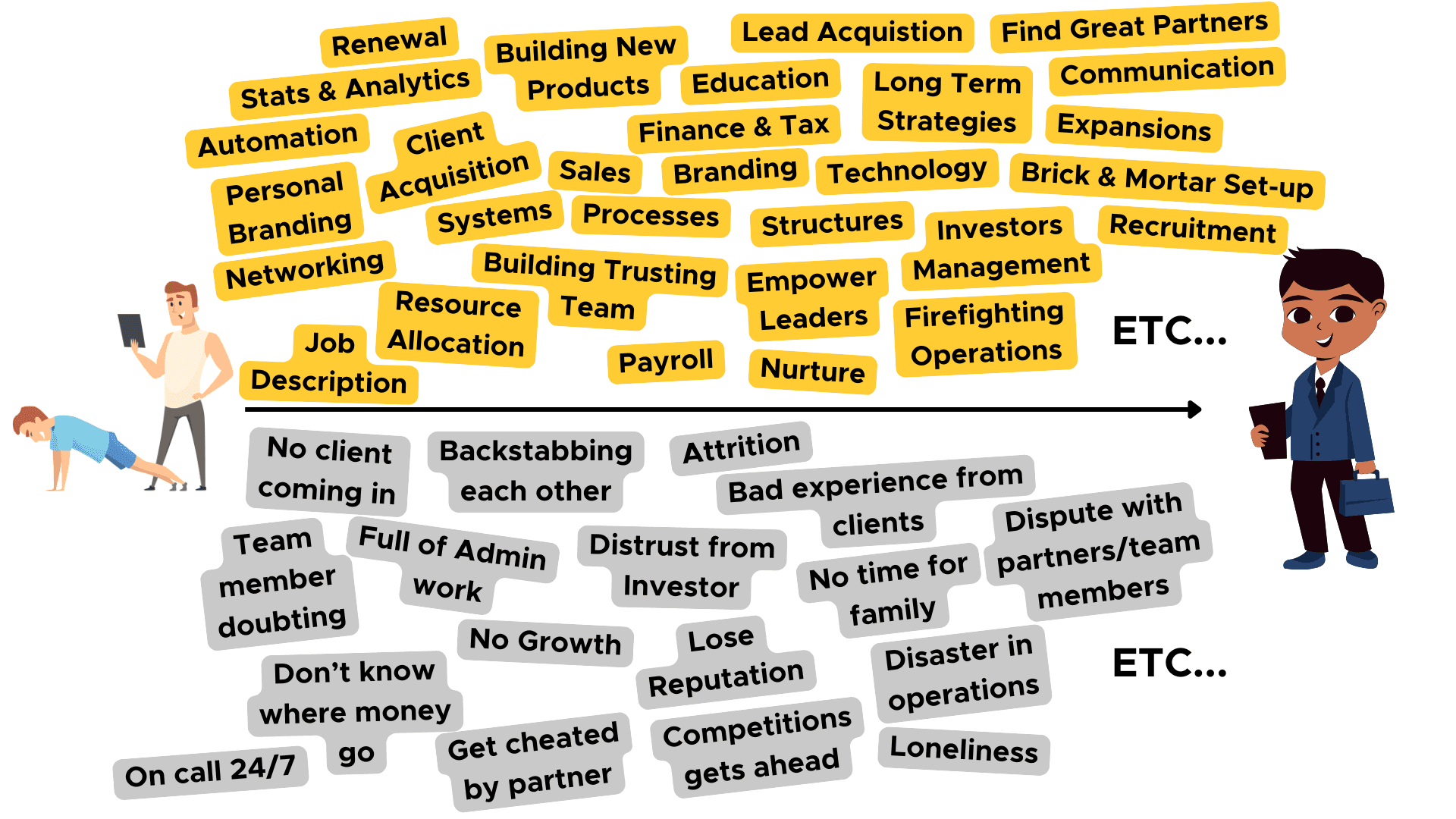
As we scaled MOVE Private Fitness, we discovered that the transition from trainer to entrepreneur required more than just skill—it required a shift in mindset, toolsets, and an entirely new approach to problem-solving. Just like the illustration below (The route to transition from trainer to entrepreneur), if any of the critical areas above the line are neglected, one or more of the consequences below will inevitably follow.
But how could we possibly master all of these areas on our own?
A well-known concept, popularized by Malcolm Gladwell in Outliers, suggests:
100 hours – Competent: Able to grasp the basics and perform a skill with confidence.
1,000 hours – Expert: Able to solve complex problems and stand out in your field.
10,000 hours – Mastery: Able to set new standards, innovate, and redefine a field.
This was Gladwell’s interpretation, highlighting the role of time and intentional practice in learning new skills.
Sure, we could accelerate learning by surrounding ourselves with the right people, absorbing knowledge, and seeking insights from those ahead of us. But even if we were born with five hands and five eyes, we doubt we could master and execute every domain at the highest level.
That’s when we realized something fundamental: We needed a team. Not just any team, but a highly-trustable, highly-collaborative, and competent one that could create real value together.
While MOVE Private Fitness is still evolving, we’re proud to see that it’s on a great trajectory—To help trainers with the transition of becoming successful entrepreneurs (In this context, we define entrepreneurship as someone who owns or builds vehicles that generate and sustain long-term stored value.).
Business Is a Team Sport
So why do we say business is a team sport? Although, it can be played solo (haha...gotcha with the title! but if you clicked in, chances are you agree—at least to some extent).
As for our believes in avantej, high-performance businesses share the same principles as elite sports teams.
Here’s why:
The Law of the Lid in Leadership
Your company’s growth is directly tied to the leadership capacity of your team. If you have level 8–10 leaders in your business, your team will rise to meet that level. Surround yourself with high-level leadership, and you’ll see leaders pop up like mushrooms in your organization. Conversely, if your 1st team is weak, your business will always struggle with a low-performance ceiling.
At avantej, we emphasize attracting and developing high-level leaders because they set the tone for the entire organization. With a victor’s mindset instead of a victim’s mindset, leaders drive solutions, build momentum, and create a culture where performance thrives.
Ultimate accountability
Great leadership teams develop strong relationships, but friendship should never get in the way of accountability.
Teams performing at the highest level in sports or business understand that accountability comes before comfort—everyone holds each other to the highest standards, pushing boundaries beyond what’s comfortable.
An unspoken rule of ultimate accountability must be instilled to bring out the best in every team member. Here’s a great clip that exemplifies this principle:
Standards Over Performance
In the highest levels of sports, standards drive performance. Whether junior or senior, every team member plays a role in upholding the highest expectations. Over time, the focus shifts from simply hitting targets to continuously raising the bar, knowing that excellence isn’t a one-time achievement—it’s a commitment to constant growth.
In both business and sports, the most dangerous performance is high output with low standards. It tricks teams into complacency, making them believe they’ve “arrived”—when in reality, it’s only a matter of time before decline sets in.
Why Ambitious Goals Matter
One of our primary goals when working with founders is to help them achieve ≥2x company revenue growth year-on-year. Why? Because exponential growth creates momentum. If a company maintains 1.1x - 1.3x growth, especially in its early years, the trajectory remains linear, making it difficult to attract top-tier talent and resources.
High-growth businesses attract high-caliber players. And a strong team makes scaling inevitable.
You may wonder, why set such big goals? Why take on the added pressure?
As Jim Collins explains in Good to Great, Big Hairy Audacious Goals (BHAGs) are essential for growth and clarity. A company is either growing or declining—there is no in-between. Without bold, ambitious goals, there’s no compelling reason for high-caliber individuals to join, no driving force to push the business forward. The best talent gravitates toward challenges that demand excellence.
Playing in Positions
In football, every player has a specific role—striker, defender, midfielder—all working toward a common goal: winning the championship.
Business is similar. If you want exponential growth, your leadership team must be multi-disciplinary, ensuring all critical areas are covered by great team members ready to rise to the challenge.
Thierry Henry, one of the greatest strikers in football history, experienced a critical lesson when he joined FC Barcelona. Used to being the superstar striker, Henry initially struggled when he was assigned a specific role within Barcelona’s rigid system. He found himself frustrated—he wasn’t getting the ball, and he wasn’t scoring goals. In an attempt to contribute more, he started drifting from his position, moving from right to left, trying to be involved in the game more actively. Eventually, he scored a goal. However, moments later, he was substituted.
Years later, Henry reflected on this experience and recognized Barcelona’s philosophy. At the time, the club had yet to reach its peak, but their dedication to a structured, strategic & collaborative style of play paved the way for their dominance in world football over the next decade. Every player had a defined role, with no one adopting a superstar mindset, and by embracing this approach, the team thrived.
This philosophy mirrors our approach at avantej & partnering founders/companies. Great leaders understand when to trust the structure, master their roles, and execute within the system—while also knowing when to challenge norms, rethink strategies, and push boundaries for the greater good of the team. Striking this balance allows us to build organizations that are not just scalable and efficient, but also adaptable, resilient, and primed for long-term success.
Ready to Build a High-Performance Business?
If you’re serious about building a high-performance business with a world-class team, reach out to us at avantej. We hold ourselves and our partners accountable to their goals—and we expect the same in return. Let’s push boundaries together and create something extraordinary.
Realizing Big Vision Can’t Be Built Alone
Our journey began with MOVE Private Fitness, a venture founded by two trainers—CJ and Justin—who shared a vision: to help trainers transition into entrepreneurs. We knew firsthand how tough this transition was—after all, we had already crashed and burned in previous ventures on ourselves. Yet here we were, boldly setting out to help other trainers become entrepreneurs. That’s a pretty bold move—not sure if we were thinking right back then, but courage and optimism definitely made us take action.
We barely knew how to run a business, build a team, or scale sustainably, and now we were inviting others to join the ride.
We didn’t know where to start. Our peers faced the same struggle—full of passion but lacking the necessary skillsets to navigate the entrepreneurial journey. The deeper we went, the more we realized just how many unknowns there were. From financial management, operations, and marketing to team-building, leadership, and automation, the list was endless.
Despite this, we had one belief: If we could solve this problem for ourselves, we could help others do the same. By setting a clear mission to help trainers succeed as entrepreneurs, we attracted talented individuals who were equally driven to transform the industry. Changing the employee to employer dynamics together. We learned how to foster a deep sense of ownership in team member and providing opportunities for equity participation to attract great talents—creating better & stronger businesses together rather than hoarding everything for ourselves. This meant having less at the start, but ultimately building something much greater by playing business like a high-level team sport rather than an individual game.
The Reality of Entrepreneurship
As we scaled MOVE Private Fitness, we discovered that the transition from trainer to entrepreneur required more than just skill—it required a shift in mindset, toolsets, and an entirely new approach to problem-solving. Just like the illustration below (The route to transition from trainer to entrepreneur), if any of the critical areas above the line are neglected, one or more of the consequences below will inevitably follow.
But how could we possibly master all of these areas on our own?
A well-known concept, popularized by Malcolm Gladwell in Outliers, suggests:
100 hours – Competent: Able to grasp the basics and perform a skill with confidence.
1,000 hours – Expert: Able to solve complex problems and stand out in your field.
10,000 hours – Mastery: Able to set new standards, innovate, and redefine a field.
This was Gladwell’s interpretation, highlighting the role of time and intentional practice in learning new skills.
Sure, we could accelerate learning by surrounding ourselves with the right people, absorbing knowledge, and seeking insights from those ahead of us. But even if we were born with five hands and five eyes, we doubt we could master and execute every domain at the highest level.
That’s when we realized something fundamental: We needed a team. Not just any team, but a highly-trustable, highly-collaborative, and competent one that could create real value together.
While MOVE Private Fitness is still evolving, we’re proud to see that it’s on a great trajectory—To help trainers with the transition of becoming successful entrepreneurs (In this context, we define entrepreneurship as someone who owns or builds vehicles that generate and sustain long-term stored value.).
Business Is a Team Sport
So why do we say business is a team sport? Although, it can be played solo (haha...gotcha with the title! but if you clicked in, chances are you agree—at least to some extent).
As for our believes in avantej, high-performance businesses share the same principles as elite sports teams.
Here’s why:
The Law of the Lid in Leadership
Your company’s growth is directly tied to the leadership capacity of your team. If you have level 8–10 leaders in your business, your team will rise to meet that level. Surround yourself with high-level leadership, and you’ll see leaders pop up like mushrooms in your organization. Conversely, if your 1st team is weak, your business will always struggle with a low-performance ceiling.
At avantej, we emphasize attracting and developing high-level leaders because they set the tone for the entire organization. With a victor’s mindset instead of a victim’s mindset, leaders drive solutions, build momentum, and create a culture where performance thrives.
Ultimate accountability
Great leadership teams develop strong relationships, but friendship should never get in the way of accountability.
Teams performing at the highest level in sports or business understand that accountability comes before comfort—everyone holds each other to the highest standards, pushing boundaries beyond what’s comfortable.
An unspoken rule of ultimate accountability must be instilled to bring out the best in every team member. Here’s a great clip that exemplifies this principle:
Standards Over Performance
In the highest levels of sports, standards drive performance. Whether junior or senior, every team member plays a role in upholding the highest expectations. Over time, the focus shifts from simply hitting targets to continuously raising the bar, knowing that excellence isn’t a one-time achievement—it’s a commitment to constant growth.
In both business and sports, the most dangerous performance is high output with low standards. It tricks teams into complacency, making them believe they’ve “arrived”—when in reality, it’s only a matter of time before decline sets in.
Why Ambitious Goals Matter
One of our primary goals when working with founders is to help them achieve ≥2x company revenue growth year-on-year. Why? Because exponential growth creates momentum. If a company maintains 1.1x - 1.3x growth, especially in its early years, the trajectory remains linear, making it difficult to attract top-tier talent and resources.
High-growth businesses attract high-caliber players. And a strong team makes scaling inevitable.
You may wonder, why set such big goals? Why take on the added pressure?
As Jim Collins explains in Good to Great, Big Hairy Audacious Goals (BHAGs) are essential for growth and clarity. A company is either growing or declining—there is no in-between. Without bold, ambitious goals, there’s no compelling reason for high-caliber individuals to join, no driving force to push the business forward. The best talent gravitates toward challenges that demand excellence.
Playing in Positions
In football, every player has a specific role—striker, defender, midfielder—all working toward a common goal: winning the championship.
Business is similar. If you want exponential growth, your leadership team must be multi-disciplinary, ensuring all critical areas are covered by great team members ready to rise to the challenge.
Thierry Henry, one of the greatest strikers in football history, experienced a critical lesson when he joined FC Barcelona. Used to being the superstar striker, Henry initially struggled when he was assigned a specific role within Barcelona’s rigid system. He found himself frustrated—he wasn’t getting the ball, and he wasn’t scoring goals. In an attempt to contribute more, he started drifting from his position, moving from right to left, trying to be involved in the game more actively. Eventually, he scored a goal. However, moments later, he was substituted.
Years later, Henry reflected on this experience and recognized Barcelona’s philosophy. At the time, the club had yet to reach its peak, but their dedication to a structured, strategic & collaborative style of play paved the way for their dominance in world football over the next decade. Every player had a defined role, with no one adopting a superstar mindset, and by embracing this approach, the team thrived.
This philosophy mirrors our approach at avantej & partnering founders/companies. Great leaders understand when to trust the structure, master their roles, and execute within the system—while also knowing when to challenge norms, rethink strategies, and push boundaries for the greater good of the team. Striking this balance allows us to build organizations that are not just scalable and efficient, but also adaptable, resilient, and primed for long-term success.
Ready to Build a High-Performance Business?
If you’re serious about building a high-performance business with a world-class team, reach out to us at avantej. We hold ourselves and our partners accountable to their goals—and we expect the same in return. Let’s push boundaries together and create something extraordinary.
Realizing Big Vision Can’t Be Built Alone
Our journey began with MOVE Private Fitness, a venture founded by two trainers—CJ and Justin—who shared a vision: to help trainers transition into entrepreneurs. We knew firsthand how tough this transition was—after all, we had already crashed and burned in previous ventures on ourselves. Yet here we were, boldly setting out to help other trainers become entrepreneurs. That’s a pretty bold move—not sure if we were thinking right back then, but courage and optimism definitely made us take action.
We barely knew how to run a business, build a team, or scale sustainably, and now we were inviting others to join the ride.
We didn’t know where to start. Our peers faced the same struggle—full of passion but lacking the necessary skillsets to navigate the entrepreneurial journey. The deeper we went, the more we realized just how many unknowns there were. From financial management, operations, and marketing to team-building, leadership, and automation, the list was endless.
Despite this, we had one belief: If we could solve this problem for ourselves, we could help others do the same. By setting a clear mission to help trainers succeed as entrepreneurs, we attracted talented individuals who were equally driven to transform the industry. Changing the employee to employer dynamics together. We learned how to foster a deep sense of ownership in team member and providing opportunities for equity participation to attract great talents—creating better & stronger businesses together rather than hoarding everything for ourselves. This meant having less at the start, but ultimately building something much greater by playing business like a high-level team sport rather than an individual game.
The Reality of Entrepreneurship
As we scaled MOVE Private Fitness, we discovered that the transition from trainer to entrepreneur required more than just skill—it required a shift in mindset, toolsets, and an entirely new approach to problem-solving. Just like the illustration below (The route to transition from trainer to entrepreneur), if any of the critical areas above the line are neglected, one or more of the consequences below will inevitably follow.
But how could we possibly master all of these areas on our own?
A well-known concept, popularized by Malcolm Gladwell in Outliers, suggests:
100 hours – Competent: Able to grasp the basics and perform a skill with confidence.
1,000 hours – Expert: Able to solve complex problems and stand out in your field.
10,000 hours – Mastery: Able to set new standards, innovate, and redefine a field.
This was Gladwell’s interpretation, highlighting the role of time and intentional practice in learning new skills.
Sure, we could accelerate learning by surrounding ourselves with the right people, absorbing knowledge, and seeking insights from those ahead of us. But even if we were born with five hands and five eyes, we doubt we could master and execute every domain at the highest level.
That’s when we realized something fundamental: We needed a team. Not just any team, but a highly-trustable, highly-collaborative, and competent one that could create real value together.
While MOVE Private Fitness is still evolving, we’re proud to see that it’s on a great trajectory—To help trainers with the transition of becoming successful entrepreneurs (In this context, we define entrepreneurship as someone who owns or builds vehicles that generate and sustain long-term stored value.).
Business Is a Team Sport
So why do we say business is a team sport? Although, it can be played solo (haha...gotcha with the title! but if you clicked in, chances are you agree—at least to some extent).
As for our believes in avantej, high-performance businesses share the same principles as elite sports teams.
Here’s why:
The Law of the Lid in Leadership
Your company’s growth is directly tied to the leadership capacity of your team. If you have level 8–10 leaders in your business, your team will rise to meet that level. Surround yourself with high-level leadership, and you’ll see leaders pop up like mushrooms in your organization. Conversely, if your 1st team is weak, your business will always struggle with a low-performance ceiling.
At avantej, we emphasize attracting and developing high-level leaders because they set the tone for the entire organization. With a victor’s mindset instead of a victim’s mindset, leaders drive solutions, build momentum, and create a culture where performance thrives.
Ultimate accountability
Great leadership teams develop strong relationships, but friendship should never get in the way of accountability.
Teams performing at the highest level in sports or business understand that accountability comes before comfort—everyone holds each other to the highest standards, pushing boundaries beyond what’s comfortable.
An unspoken rule of ultimate accountability must be instilled to bring out the best in every team member. Here’s a great clip that exemplifies this principle:
Standards Over Performance
In the highest levels of sports, standards drive performance. Whether junior or senior, every team member plays a role in upholding the highest expectations. Over time, the focus shifts from simply hitting targets to continuously raising the bar, knowing that excellence isn’t a one-time achievement—it’s a commitment to constant growth.
In both business and sports, the most dangerous performance is high output with low standards. It tricks teams into complacency, making them believe they’ve “arrived”—when in reality, it’s only a matter of time before decline sets in.
Why Ambitious Goals Matter
One of our primary goals when working with founders is to help them achieve ≥2x company revenue growth year-on-year. Why? Because exponential growth creates momentum. If a company maintains 1.1x - 1.3x growth, especially in its early years, the trajectory remains linear, making it difficult to attract top-tier talent and resources.
High-growth businesses attract high-caliber players. And a strong team makes scaling inevitable.
You may wonder, why set such big goals? Why take on the added pressure?
As Jim Collins explains in Good to Great, Big Hairy Audacious Goals (BHAGs) are essential for growth and clarity. A company is either growing or declining—there is no in-between. Without bold, ambitious goals, there’s no compelling reason for high-caliber individuals to join, no driving force to push the business forward. The best talent gravitates toward challenges that demand excellence.
Playing in Positions
In football, every player has a specific role—striker, defender, midfielder—all working toward a common goal: winning the championship.
Business is similar. If you want exponential growth, your leadership team must be multi-disciplinary, ensuring all critical areas are covered by great team members ready to rise to the challenge.
Thierry Henry, one of the greatest strikers in football history, experienced a critical lesson when he joined FC Barcelona. Used to being the superstar striker, Henry initially struggled when he was assigned a specific role within Barcelona’s rigid system. He found himself frustrated—he wasn’t getting the ball, and he wasn’t scoring goals. In an attempt to contribute more, he started drifting from his position, moving from right to left, trying to be involved in the game more actively. Eventually, he scored a goal. However, moments later, he was substituted.
Years later, Henry reflected on this experience and recognized Barcelona’s philosophy. At the time, the club had yet to reach its peak, but their dedication to a structured, strategic & collaborative style of play paved the way for their dominance in world football over the next decade. Every player had a defined role, with no one adopting a superstar mindset, and by embracing this approach, the team thrived.
This philosophy mirrors our approach at avantej & partnering founders/companies. Great leaders understand when to trust the structure, master their roles, and execute within the system—while also knowing when to challenge norms, rethink strategies, and push boundaries for the greater good of the team. Striking this balance allows us to build organizations that are not just scalable and efficient, but also adaptable, resilient, and primed for long-term success.
Ready to Build a High-Performance Business?
If you’re serious about building a high-performance business with a world-class team, reach out to us at avantej. We hold ourselves and our partners accountable to their goals—and we expect the same in return. Let’s push boundaries together and create something extraordinary.
Feb 12, 2025